I've been watching season 5 of Clarkson's Farm. I've been a huge fan of the show through all four seasons before this one, because it made me think a lot more about farming. It's set in the UK, but I'd bet farming there isn't all that different from farming here.
I grew up in the suburbs and I've lived in cities my whole adult life. I never really thought much about where our food comes from, or about all the people, tasks, and work that go into getting from seed to food on a table. This show opened my eyes to it. The challenges, the hard work, the peril, the risk, and the reward. Animals that don't make it. Crops that get blighted. Harvests that get rejected or fetch less at market than you planned around. Equipment that breaks at the worst possible moment. All that stuff.
Then episode 3 happened
In season 5, episode 3, Jeremy takes Kaleb on his first ever trip abroad, to the Netherlands, to meet farmers using some of the most advanced techniques in the world. Their minds are blown. Honestly, so was mine.
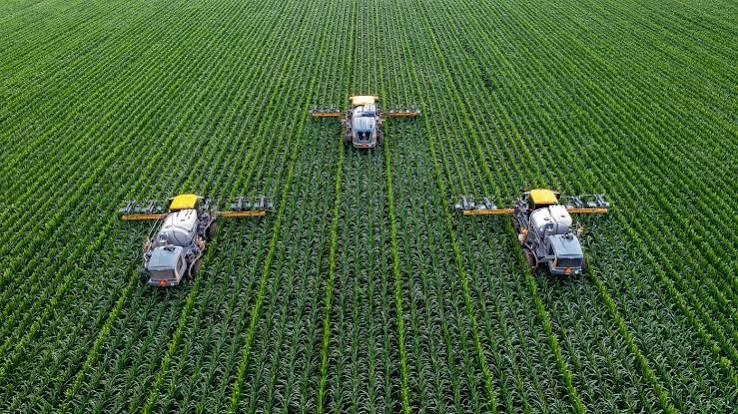
They watch drones and combines map farmland down to the centimeter, then make their own turns once the field is mapped. They watch a drone identify weeds from the air and spray only the weeds, never the crops, covering a gigantic field in under eight minutes.
Then they visit a dairy farmer who built a self-sustaining farm that floats on the water. Solar panels power desalination equipment that, with help from the cows' own dung, turns river water into drinking water for the herd. The cows eat stale bread from the local bakery and food from town that would otherwise go unsold. The cheese gets made in a concrete cellar floating right there in the water. The cows roam free. They produce great dairy, and they do it all in a closed loop. It's an amazing operation.
The machines come to Diddly Squat
Jeremy, being Jeremy, buys similar technology and flies the farmers he met out to his own farm to set it up.
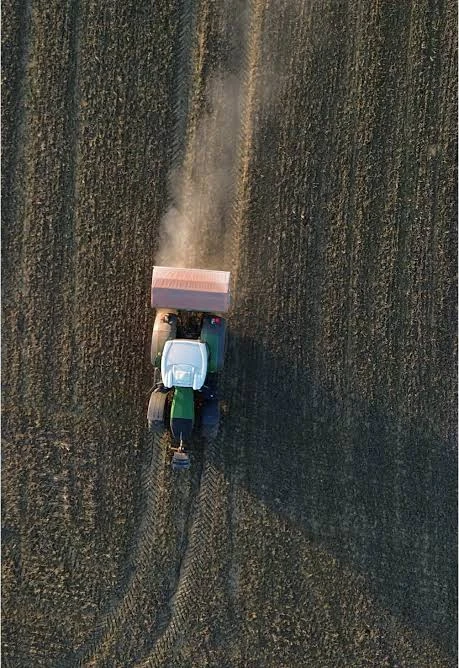
He gets a spreader that fertilizes his fields with rhino dung from the local wildlife park, and it decides on its own which patches of soil need more or less based on what it reads in the ground right now. You can watch it lay it on heavier in one spot and lighter in another. Then an autonomous cultivator he calls the agbot turns up the soil after the fertilizer goes down, completely on its own, nobody at the controls. And then a solar powered droid drops onion seeds into the ground exactly 15 centimeters apart and remembers where every single seed is, all mapped by cameras. They actually measure it. 15 centimeters on the dot, without a human ever touching the machine.
And while the machines work the fields, Jeremy and Kaleb get to do the housekeeping the farm actually needs. He upgrades his office so he can see exactly where each machine is, what it's doing, and how it's doing it, from a screen. In one of my favorite moments of the whole series, he and Lisa have date night out on the farm, watching the two machines quietly do their thing under the night sky. Jeremy declares that the Starship Enterprise has just landed at Diddly Squat. It's so funny, and he's not wrong.
Yes, there's a catch
Of course, the reason Jeremy can adopt all of this so quickly is that he has loads of money. He can buy multiple $500,000 tractors, plus the software and AI to run them. Most farmers can't.
But I really appreciate what he's doing, because it's an example of what technology and AI can actually do for us. Those machines farm with less time, less fuel, less spray, and less waste. The drone that sprays only the weeds uses a fraction of the chemicals a blanket pass would. The spreader puts fertilizer only where the soil needs it. The droid plants once, precisely, with no do-overs. Less wasted material, less wasted energy, less wasted time. And every hour the machines give back goes straight into the hundred other things a farm needs, the things only a person can do.
What this means for the rest of us
I run a small business too, and most of the people we work with run trades, home services, or distribution companies. When AI comes up, I usually hear one of two reactions: it's a threat, or it's a toy. I understand both. But watching a robot plant onions convinced me there's a better way to see it: as an opportunity to be more responsible with what we already have.
None of us needs a half-million-dollar machine to get this kind of leverage. At our size, a plumbing company, an HVAC shop, a small distributor, it looks like scheduling that routes techs sensibly instead of criss-crossing the county burning gas. Quotes that get built in minutes instead of eating our evenings. Invoices that go out the day the job closes instead of three weeks later. A system that answers "when will you be there?" so nobody has to stop what they're doing. Fewer wasted trips, fewer materials ordered twice, fewer hours lost to paperwork. More done with the same crew and the same day.
It's the same story as the drone that only sprays the weeds. Use fewer resources, whether that's time, materials, fuel, or energy, to do more and go further. That's what makes this stuff revolutionary. It makes the work easier, it frees us up for the parts of the job that actually need us, and it does all that while wasting less.
Near the end of the episode, out in that field with the machines humming along, Jeremy says, "On a night like tonight, farming is the best job in the world."
The machines gave him that evening back and that's the whole point.
Want to talk through where this could fit? Book a free call.